

Chronic Pain’s Plus-Ones
Written by: Lauren Siegfried, LCPC
Working with adolescents in therapy, it quickly becomes clear that chronic pain rarely exists alone. It often appears alongside anxiety, depression, and a gradual withdrawal from everyday life. What may start as recurring headaches, stomachaches, or musculoskeletal discomfort can evolve into a more complex experience affecting emotional, social, and academic functioning. Research by Bhatt et al. (2020), along with studies in JAMA Pediatrics and Pain Research and Management, shows adolescent chronic pain is closely related to emotional well-being and cannot be understood in isolation.
In therapy, adolescents with chronic pain rarely focus solely on physical symptoms. More often, they describe missing school, strained or fading friendships, and an increased sense that their world is shrinking. Alongside the pain, there is frequently persistent worry, irritability, low mood, and frustration, both with their bodies and the limitations their bodies impose. Research reported in JAMA Pediatrics indicates that a significant proportion of youth with chronic pain also meet criteria for anxiety or depressive disorders, reinforcing that this overlap is common rather than incidental.
Chronic pain has a bidirectional relationship with emotional distress. Pain can amplify anxiety and depression, while emotional stress can increase the experience of pain. Rather than a simple cause-and-effect relationship, this pattern functions more like a feedback loop. Clinically, it commonly manifests as catastrophizing thoughts (“This will never improve”), avoidance behaviors (e.g., skipping activities to avoid discomfort), and a gradual narrowing of daily activities. Over time, pain can start to influence choices, daily routines, and future goals, while emotional distress becomes more persistent and difficult to shake.
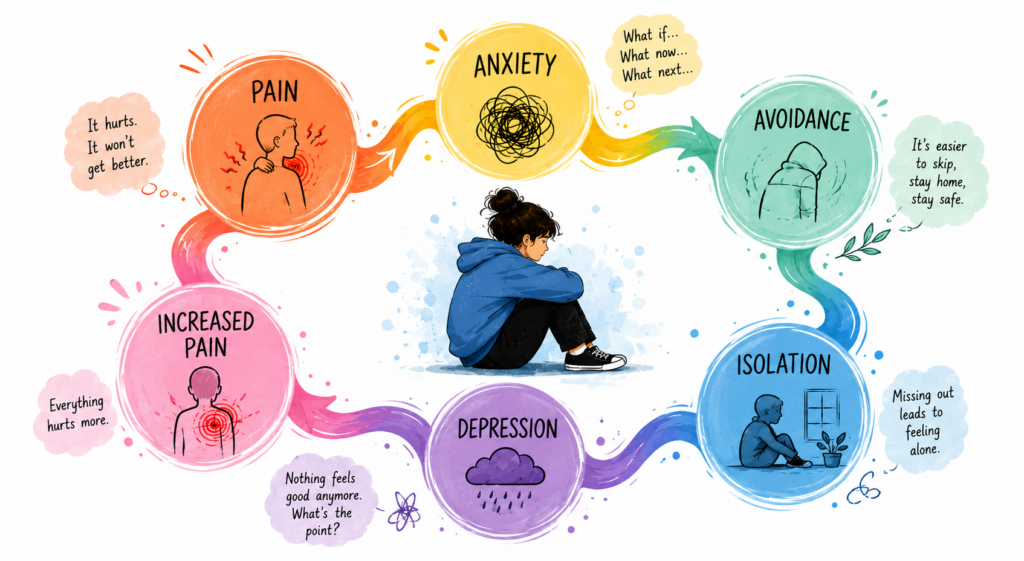
A developmental lens helps clarify why this is especially significant during adolescence. Adolescence is a time of increasing independence, identity formation, expanding social connections, and trying to figure out why Geometry feels so personally offensive. Chronic pain can disrupt each of these processes. Pediatric research suggests that these disruptions may increase vulnerability to anxiety and depression, particularly when pain persists without consistent support.
Clinical literature supports a biopsychosocial understanding of adolescent chronic pain. How adolescents interpret pain, how families and schools respond, and the availability of support influence its impact on daily functioning. Effective care, therefore, should look beyond symptom reduction to include coping skills, emotional regulation, and support for re-engagement in daily life.
Cognitive Behavioral Therapy (CBT) helps adolescents identify unhelpful thoughts, reduce avoidance, and rebuild confidence while remaining involved in daily life. Mindfulness strategies support this by helping them experience pain without becoming overwhelmed. Acceptance and Commitment Therapy (ACT) complements this approach by redirecting the focus from eliminating pain to building a meaningful life alongside it, encouraging re-engagement in school, relationships, and activities even when discomfort persists.
Research and clinical experience consistently show that chronic pain, anxiety, and depression often intersect in adolescence, but they do not have to determine a person’s trajectory. Treatment is less focused on eliminating pain completely and on supporting adolescents in creating fuller, more meaningful lives despite it. For many adolescents, these shifts represent an important step toward regaining a sense of autonomy and reclaiming their lives.
References
Bhatt, R. R., Gupta, A., & Lee, A. (2020). Chronic pain in children: Structural and resting-state functional brain imaging within a developmental perspective. Pediatric Research, 88(3), 394–402. https://doi.org/10.1038/s41390-020-0771-4
Eccleston, C., Fisher, E., Howard, R. F., Slater, R., Forgeron, P., Palermo, T. M., … & Crombez, G. (2021). Delivering transformative action in paediatric pain: A Lancet Child & Adolescent Health Commission. The Lancet Child & Adolescent Health, 5(1), 47–87.
Groenewald, C. B., Essner, B. S., Wright, D., Fesinmeyer, M. D., & Palermo, T. M. (2014). The economic costs of chronic pain among a cohort of treatment-seeking adolescents in the United States. The Journal of Pain, 15(9), 925–933.
Kashikar-Zuck, S., Cunningham, N., Sil, S., Bromberg, M. H., Lynch-Jordan, A. M., Strotman, D., … & Ting, T. V . (2016). Long-term outcomes of adolescents with juvenile-onset fibromyalgia. JAMA Pediatrics, 170(6), 535–542. https://doi.org/10.1001/jamapediatrics.2015.3934
Liossi, C., & Howard, R. F. (2016). Pediatric chronic pain: Biopsychosocial assessment and formulation. Pain Research and Management, 2016, 1–10. https://doi.org/10.1155/2016/7017495
Dudeney, J., Aaron, R. V ., Hathway, T., et al. (2024). Anxiety and depression in youth with chronic pain: A systematic review and meta-analysis. JAMA Pediatrics, 178(11), 1114–1123. https://doi.org/10.1001/jamapediatrics.2024.3039
Goldberg, R. (2024, November 22). What’s the link between chronic pain and anxiety, depression in youth? Neurology Advisor.

About Us
Learn more
Our Care
Learn more
What We Treat
Learn more